Xenomorph Chestburster
CREATURES / XENOMORPH BIOLOGY
The Chestburster is the juvenile Xenomorph that develops inside a host and emerges to begin independent life. Its small size, elongated body, rapid growth and changing anatomy distinguish this transitional life stage from both the Facehugger and the adult.
The original Nostromo juvenile, quadrupedal Bambi Burster, royal offspring and later experimental forms illustrate different developmental paths rather than a single uniform caste.
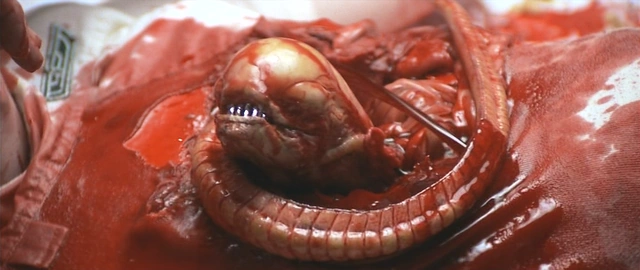
SELECT A PROFILE
Explore the Chestbursters
Select a screen depiction, licensed interpretation or related developmental form. Unillustrated records remain explicitly unillustrated.
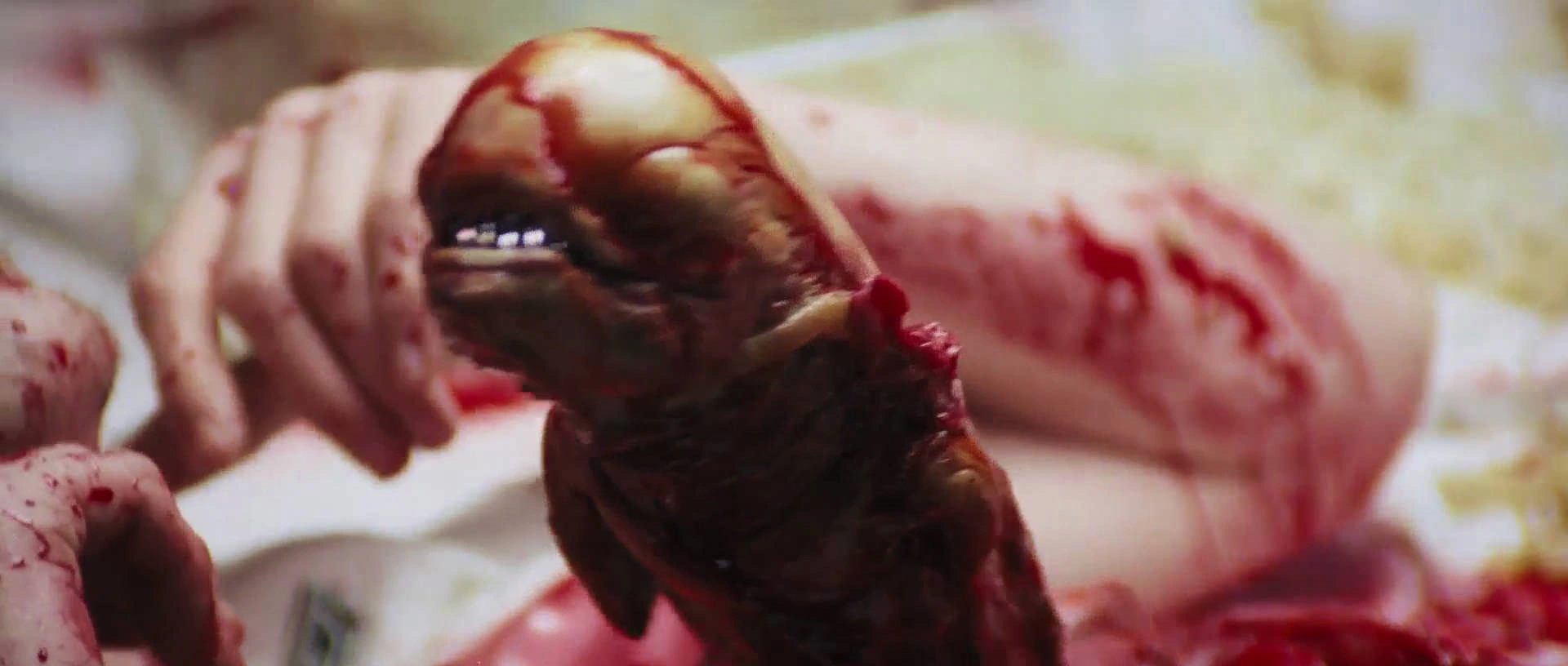
Alien (1979) · film image
Kane's Chestburster
The original newborn escapes the Nostromo crew and develops into Big Chap.
- Designation
- Standard human-host juvenile
- Visual cue
- Pale dome, teeth, long tail, tiny vestigial limbs
- Source status
- Released film
Source details
The film shows rapid growth and discarded skin, not a measured growth rate.
No image available.
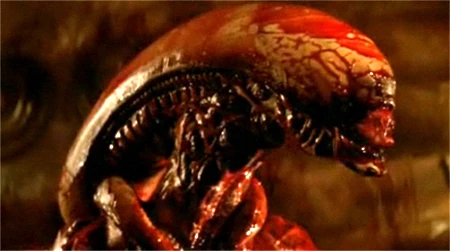
Alien 3 (1992) · film image; cut identification pending
Bambi Burster
The creature born from Spike or the ox develops into the Runner.
- Designation
- Quadrupedal juvenile / Bambi Burster
- Visual cue
- Developed limbs and adult-like head
- Source status
- Released film; host differs by cut
Source details
The different hosts belong to different edits; Bambi Burster is a production nickname later used by the RPG.
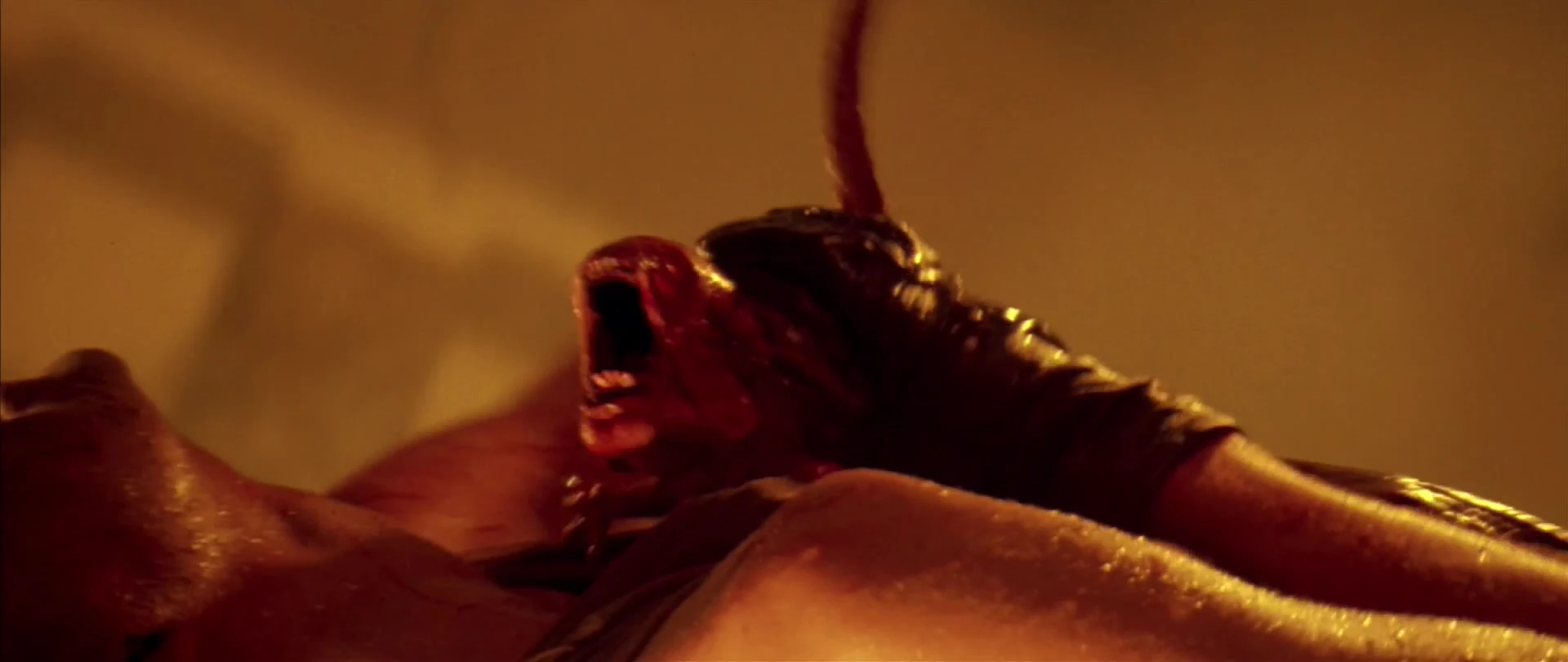
Alien 3 (1992) · theatrical ending
Queenburster
Ripley carries a Queen embryo and rejects the Company's attempt to recover it.
- Designation
- Queen-bound juvenile
- Visual cue
- Royal head and body; not a normal juvenile
- Source status
- Theatrical emergence; Assembly Cut differs
Source details
The theatrical ending depicts emergence; the Assembly Cut does not.
No image available.
Cloned-lineage Chestburster
The laboratory's human hosts sustain the next generation; Purvis carries an embryo.
- Designation
- Juvenile from cloned Queen lineage
- Visual cue
- Traditional elongated body in altered lineage
- Source status
- Released film
Source details
The hybrid Newborn is a different organism delivered by the Queen.
No image available.
Pyramid Chestburster
The Antarctic pyramid's ritual sacrifices supply hosts.
- Designation
- Human-host juvenile
- Visual cue
- Classic elongated body
- Source status
- Released crossover film
Source details
The rapid timeline is not proof of a universal incubation period.
No image available.
Predalien juvenile
The infected Predator Scar becomes the host of a Predalien.
- Designation
- Predator-derived offspring
- Visual cue
- Host-associated mandibular structures
- Source status
- Released crossover films
Source details
The subsequent adult's reproductive mechanism is unusual and distinct from ordinary Facehugger implantation.
No image available.
Oram's juvenile
Oram's offspring stands upright soon after emergence.
- Designation
- Praetomorph juvenile; Imp in licensed RPG terminology
- Visual cue
- Miniature adult-like body and limbs
- Source status
- Released film; later classification
Source details
The production version differs from the 1979 serpent-like design.
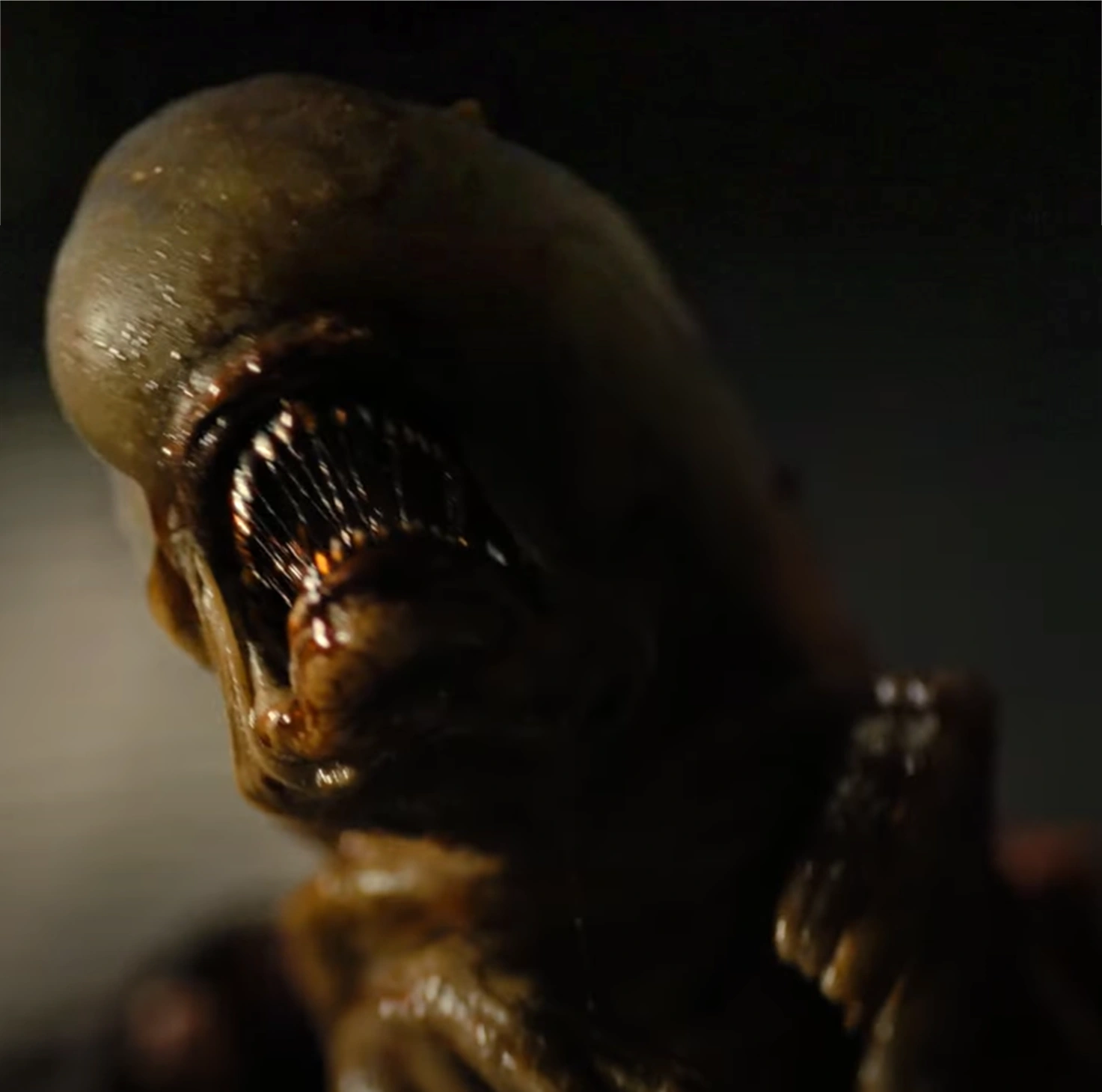
Alien: Romulus (2024) · film image
Navarro's Chestburster
The juvenile escapes and a larger Alien later emerges from a chrysalis.
- Designation
- Research-derived juvenile
- Visual cue
- Small, translucent-to-dark dome and visible limbs
- Source status
- Released film
Source details
The chrysalis is observable in this film; universality is not established.
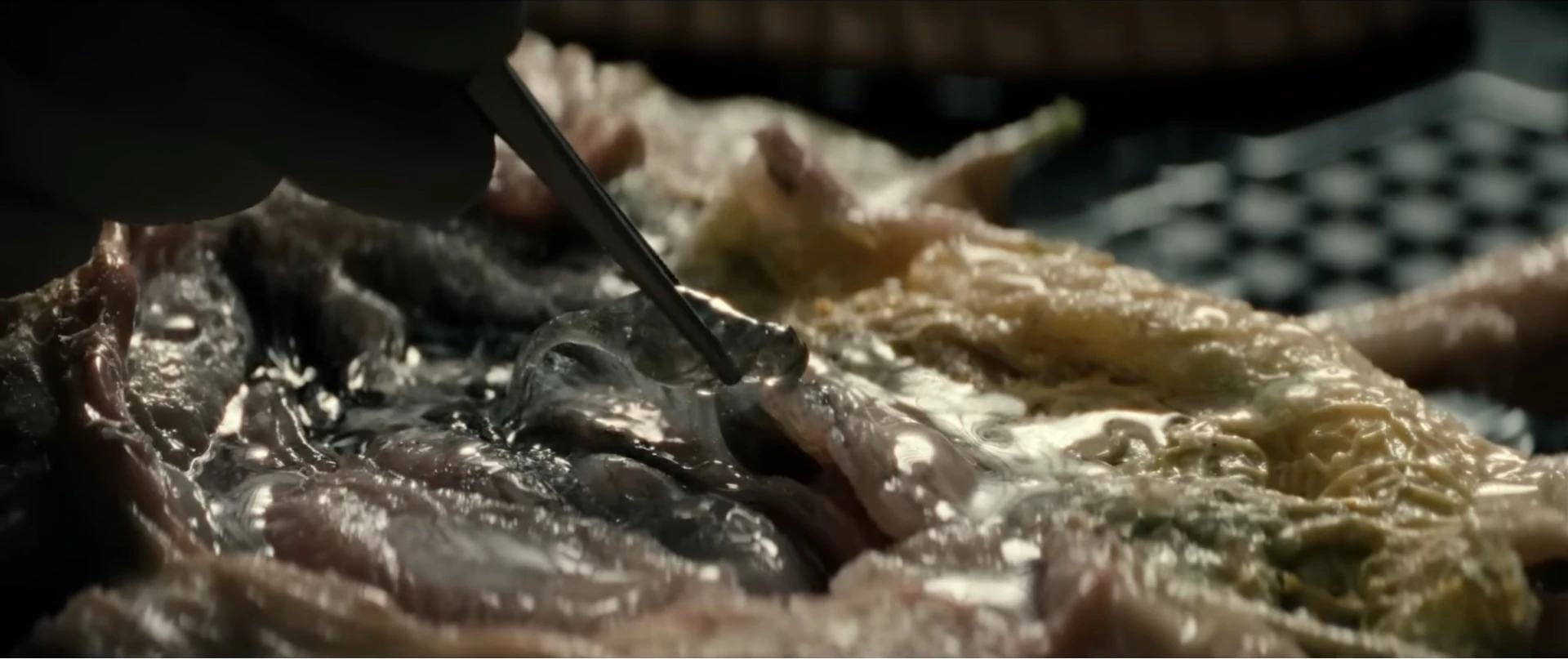
Alien: Earth (2025) · S1E3, pre-emergence stage
Extracted larva
Kirsh extracts the developing organism from a Facehugger in episode 3.
- Designation
- Pre-host embryonic/larval stage
- Visual cue
- Small translucent organism
- Source status
- Released television; not emerged Chestburster
Source details
This visual concerns an earlier stage, not an adult caste or a newly named Chestburster subtype.
No image available.
Arthur's Chestburster
Arthur's infection culminates in emergence in episode 7.
- Designation
- Human-host juvenile
- Visual cue
- Conventional emergence
- Source status
- Released television
Source details
The production team documented the practical animatronic sequence in 2026.
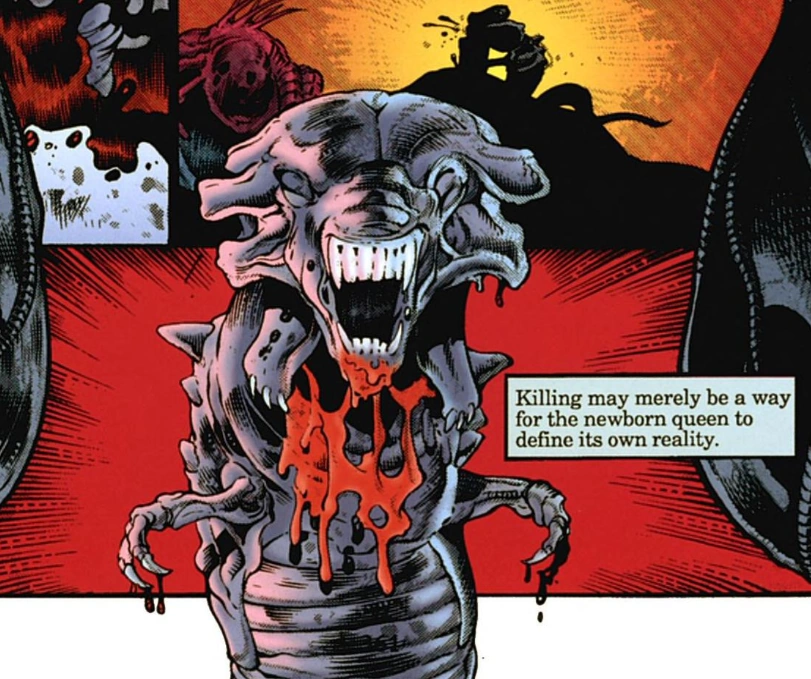
Theory of Alien Propagation (1988) · comic panel; exact page pending
Newborn Queen — comic interpretation
Theory of Alien Propagation explores newborn Queen behavior in a speculative illustrated report.
- Designation
- Royal juvenile in a fictional research paper
- Visual cue
- Broad ornate head and multiple arms
- Source status
- Licensed comic; in-universe hypothesis
Source details
The paper's theories are not objective film biology.
No image available.
Playable Chestburster
The Alien campaign lets the player experience the early stages before adulthood.
- Designation
- Playable juvenile
- Visual cue
- Low profile; movement limitations
- Source status
- Licensed game
Source details
Gameplay objectives and growth triggers are not universal anatomy.
No image available.
Bloodburster
Neomorphs develop after exposure to spores and emerge through different body regions.
- Designation
- Neomorph juvenile; separate developmental lineage
- Visual cue
- Pale, organic juvenile
- Source status
- Released film; licensed taxonomy
Source details
Not an ordinary XX121 Chestburster; compare rather than merge.
Terminology and classification
Section titled “Terminology and classification”The Chestburster is the juvenile form that develops within a host and, upon emergence, becomes a free-living organism. In the first film the characters do not establish a formal caste name for the newborn. Later licensed sources designate it a distinct stage of XX121 development. The term describes a phase rather than an adult social role. The original is the juvenile of the individual later called Big Chap. 1 21
| Attribute | Reference |
|---|---|
| First released depiction | Alien (1979) |
| Life stage | Juvenile; Stage III in the 2019 ALIEN RPG |
| Preceding stage | Facehugger / implanted developing organism |
| Subsequent stage | Growing juvenile, intermediate form or adult depending on work |
| Typical morphology | Elongated body, teeth, tail; limbs vary |
| Host | Humans and other organisms in different works |
| Gestation | Variable; no universal film-established duration |
| Related forms | Bambi Burster, Queenburster, Predalien juvenile, Imp; Bloodburster is a related but distinct Neomorph stage |
Design history
Section titled “Design history”Select a record to compare the forms shown in released films and television.
1979Alien — the original juvenileFILM
Kane’s encounter in the Derelict establishes a chain of events: attachment, unconsciousness, apparent recovery and a sudden fatal emergence during the crew’s meal. The pale juvenile raises its small head and rapidly escapes. Later, Brett discovers discarded skin, before the crew encounters the full-sized Alien. The film does not show the entire transformation, nor does it measure the duration or metabolic cost of growth. 1
The original form is long and narrow, with a relatively rounded, elongated head, little visible limb articulation, and a segmented tail. The newborn is not the same morphological form as the adult, despite being the same individual. The mature organism is conventionally catalogued here as the Drone.
1986Aliens — articulated limbs and hive contextFILM
A colonist found within the Hadley’s Hope hive is already incubating an Alien; the Marines witness emergence and destroy the newborn. This shows the role of captive hosts in the hive’s reproduction, as distinct from the isolated Nostromo incident. The medical examination of stored Facehuggers separately establishes that a hive may contain multiple reproductive stages at once. 2
Stan Winston’s effects team retained much of the first film’s form while giving the juvenile visibly moving arms. These are a production design development, not a demonstrated genetic difference between Drone-bound and Warrior-bound offspring. 13
1992Alien 3 — Bambi Burster and alternate hostsFILM / EDITIONS
The animal-host offspring is substantially more developed at emergence than the 1979 juvenile. Its limbs support quadrupedal locomotion and its head already resembles its eventual adult form, the Dragon or Runner. The theatrical cut uses Spike, a dog; the Assembly Cut restores an ox-based sequence. The underlying juvenile design was developed as a four-legged creature and was called the Bambi Burster by the effects team. The RPG later uses Bambi Burster as a formal licensed category. 3 14 21
These are alternate cuts of one production, not two successive infestations on Fiorina 161. The distinct animal host outcomes support host-dependent development as a film observation, but do not establish a precise genetic inheritance mechanism.
1992Alien 3 — Ripley’s royal offspringFILM / EDITIONS
Ripley learns from a scan that she carries a Queen. The Company attempts to secure the organism alive. In the theatrical ending a juvenile emerges as Ripley falls into the furnace; the Assembly Cut omits that emergence. This establishes royal development inside a host without requiring the two versions to share identical events. 3
The royal offspring should not be described as an ordinary adult Drone or confused with the royal Facehugger. A Queen is the reproductive adult, not simply a large Chestburster. The film offers no general quantitative rule for royal gestation.
1997Alien Resurrection — a cloned lineageFILM
Scientists recover a developing Queen from the cloned Ripley, and later use captured human hosts to reproduce Aliens aboard the Auriga. Purvis is among those infected and dies during the final confrontation. This film is significant for two separate phenomena: successful surgical recovery of a royal organism in a cloning experiment, and ordinary host-based emergence among the Queen’s descendants. Neither establishes that routine surgical extraction is safe. 4
The Queen’s later live delivery of the Newborn is a distinct reproductive route resulting from the story’s genetic mixing. It is not a conventional Facehugger-derived Chestburster, and the altered adult Xenomorphs should not be classified as a juvenile caste.
2004Alien vs. Predator — ritual hostsCROSSOVER
The pyramid’s captive Queen produces Eggs for a recurring hunt. Humans are trapped and used as hosts; the resulting juveniles develop into the adults encountered by the expedition. The film compresses attachment, emergence and maturation into a short narrative interval. Its pacing does not establish an identical interval for the original film or other continuities. 5
2004–07Predalien — a Predator-derived juvenileCROSSOVER
The closing scene of Alien vs. Predator depicts a juvenile emerging from Scar aboard the Predator vessel. The next film follows the adult Predalien. Its facial morphology is associated with its Predator host. Requiem also depicts an unusual reproductive behavior in which the adult directly introduces developing offspring into human victims. This is separate from the usual Egg–Facehugger route and should not be generalized to all Predaliens or all Xenomorphs. 5 6
2017Alien: Covenant — miniature adult-like juvenileFILM
David’s Egg infects Oram, whose offspring has an immediately recognizable adult-like outline, including developed arms and legs. Its posture and gestures contrast strongly with the original wormlike form. Framestore identifies a Ridley Scott sketch and an articulated Odd Studio maquette as inputs to its digital creature. 7 15 16
The licensed RPG calls the corresponding juvenile an Imp; this later term is not dialogue in the film. The scene with Lope and the subsequent shipboard Alien supplies another example of the film’s rapid development, without explaining the relationship of David’s lineage to the Derelict cache. 7 21
2024Alien: Romulus — emergence and chrysalisFILM
Navarro uses a scanning device to observe movement inside her torso before emergence. The creature is small, with visibly articulated limbs and a head whose appearance darkens during its birth. It later develops within a wall-mounted chrysalis; a larger Xenomorph emerges from that structure. This is a directly depicted intermediate phase between juvenile and adult, rather than evidence that every earlier adult underwent the same process. 8 17 18 19
The station’s research-derived Facehuggers and the compound used on Kay belong to the same broader research program, but Kay’s Offspring has a different developmental origin. The Offspring’s sac and delivery should not be classified as an ordinary Ovomorph or ordinary Chestburster.
2025Alien: Earth — larva, emergence and juvenile developmentTELEVISION
In Metamorphosis (episode 3), Kirsh examines a recovered Egg and Facehugger and extracts a small developing organism. This is a pre-emergence larval specimen, not the independent Chestburster of the galley scene. The scene provides visual evidence for a discrete transferable organism in this series, without settling every previous account of implantation. 9
Arthur is attacked by a Facehugger in episode 6 and undergoes emergence in episode 7. Actor David Rysdahl and prosthetics supervisor Steve Painter discuss this sequence separately; Painter’s 2026 interview describes an animatronic juvenile and an artificial body. The series also develops a separate young Xenomorph and therefore broadens the visible stages between infancy and adulthood. 9 20 33
Biology and life cycle
Section titled “Biology and life cycle” OvomorphContains Facehugger
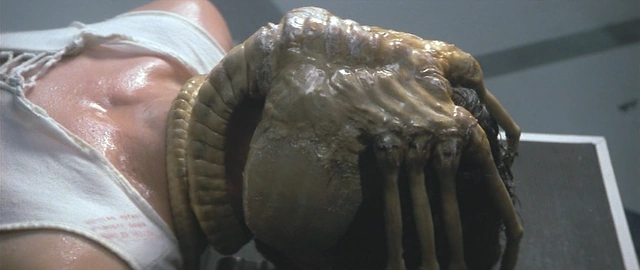 FacehuggerHost implantation
- ChestbursterIndependent juvenile
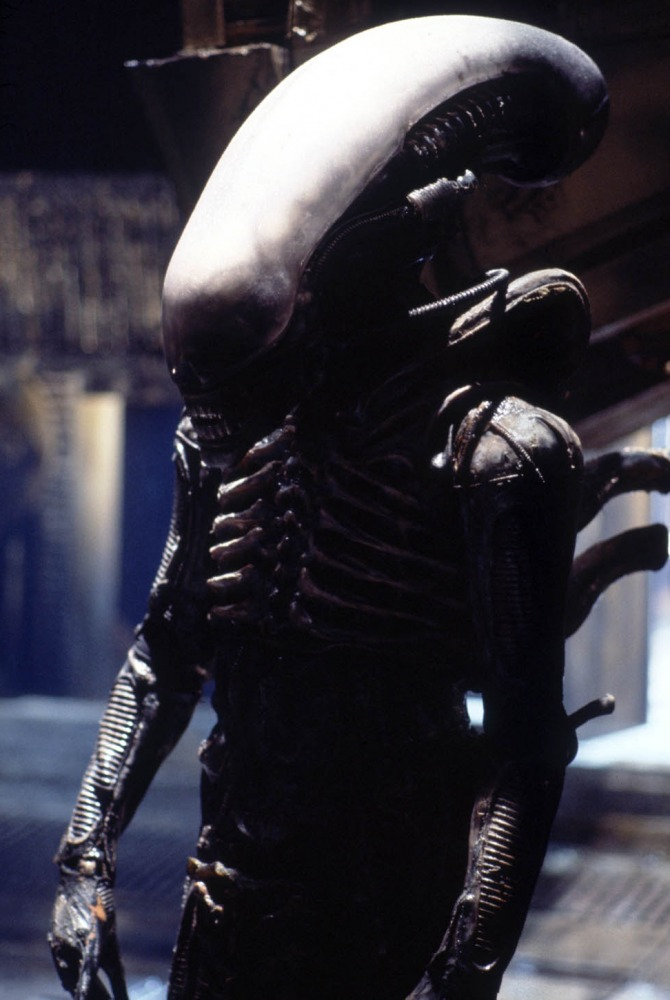 AdultOne possible mature form
This illustrated sequence shows a conventional route, not every reproductive variant. The chrysalis in Romulus and royal, animal-derived and experimental offspring complicate the simplified diagram.
01External morphology and movementANATOMY
A typical early human-host juvenile has an elongated flexible trunk, a smooth or rounded head, teeth and a tail. Developed limbs are conspicuous in Aliens, Alien 3, Covenant and Romulus, but their form differs. A visible dome does not establish fully functional adult armor. The original can move independently at high speed even though its external limbs are not prominent. A quadrupedal or miniature adult-like form can locomote differently. 1 2 3 7 8 13
The films provide no consistent measurement of mass, length, adult-equivalent jaw force or sensory range. Avoid imposing numerical dimensions from one prop or game model on every incarnation.
02Implantation and embryonic developmentLIFE CYCLE
The conventional reproductive sequence starts with an Egg (Ovomorph) releasing a Facehugger. The parasite attaches to a suitable host, and a new organism subsequently develops inside the host. Earlier films demonstrate the sequence without continuously observing the implantation process. Alien: Earth’s dissection supplies a more direct visualization of a larval form within the Facehugger. 1 2 9
The words egg, embryo, larva and Chestburster are not interchangeable. An Ovomorph contains a Facehugger; the Chestburster is the resulting developing offspring, conventionally named for the emergence phase. The 2019 core RPG explicitly places it at Stage III, following the Facehugger. Its fictional researchers debate an embryo, induced cellular growth and a bacterial symbiont; the game mechanics describe host cells transforming into the new organism. 21 21
03Gestation, symptoms and timingBIOLOGY
A host may appear to recover after detachment and resume ordinary activity before the birth, as in Alien. Other hosts remain restrained or visibly ill. A diagnosis may be possible in some stories using advanced imaging, as with Ripley and Navarro. The time between attachment and emergence varies by depiction, host and editing. 1 2 3 8
No single gestation period follows from the films. Royal development, the compressed AVP films and the Renaissance experiments are particularly important comparison cases. The 2019 core rulebook (p. 306) permits the Game Mother to vary incubation according to the story and identifies hypersleep as a possible delaying factor. Its ordinary incubation is measured in Shifts, while royal development takes days. 21 Treat game time as a rule of that edition, not an established physical constant. 22
04Emergence and host fateBIOLOGY
Most ordinary screen births are fatal to the host. The juvenile becomes independent and may flee rather than immediately confront larger opponents. The transition is not identical in every lineage: the dog/ox-host juvenile emerges in a developed four-legged form and Oram’s offspring resembles a miniature adult. 1 3 7
A birth route involving the back, mouth, or an alternate organ does not automatically make the organism a distinct species. Conversely, the Neomorph’s spore-based route does not become ordinary Xenomorph reproduction just because it also ends with a parasitic emergence.
05Growth, shedding and chrysalisDEVELOPMENT
The 1979 film supplies evidence of shedding and a dramatic increase in size between the juvenile’s escape and the adult’s appearance. Romulus adds an observable chrysalis. The speed of change is one of the creature’s defining fictional properties, yet no released film establishes a complete mass and energy budget. The 2019 RPG (p. 305) explicitly describes the young organism seeking organic food and metals, darkening, shedding and forming a resin enclosure during metamorphosis. This is a licensed explanation that anticipates the chrysalis seen in Romulus, not a complete physical model for the 1979 film. 21 1 8 19
The creature’s own maturation enclosure must also be distinguished from the resin used to immobilize hosts. A cocooned human and a developing juvenile are biologically and narratively different cases.
06Host influence and caste differentiationVARIATION
The animal-host Runner and Predator-host Predalien support the conclusion that offspring morphology can reflect host type. The human-born Imp-like form of Covenant shows that lineage/design can also alter newborn anatomy even with a human host. There is no reliable screen rule that every human-born juvenile becomes a smooth-domed Drone, nor that a visibly armed hatchling must become a Warrior. 3 5 7
The 2019 RPG distinguishes four Stage III forms: Chestburster, Bambi Burster, Imp and Queenburster. Its Stage IV includes the Stalker, Scout and Drone; later stages include Soldier, Worker, Sentry, Praetorian, Crusher and Queen. The films show diverse adults including Drones, Warriors and Queens, not a single mandatory route. 21
07Defense, acid and vulnerabilityBEHAVIOR
The juvenile’s chief advantage in the original film is its small profile and rapid escape. The Aliens newborn is destroyed before it can mature. The traditional adult and Facehugger exhibit corrosive blood, but the original film does not test the newborn’s blood chemistry independently. Licensed games and RPGs assign juvenile attack and defense abilities; those numbers are system abstractions and should not be treated as measurements. 1 2 21 22 24
08Medical intervention and exceptional survivalCONTINUITY
The films do not establish a routinely successful procedure to save ordinary implanted humans. Alien Resurrection depicts a laboratory recovery of a Queen from cloned Ripley; the experimental origin makes this an exceptional case. The licensed RPG describes attempts that have failed and the risk to both organisms. Expanded comics and crossovers include reported exceptions involving dead embryos, surgery or extraordinary technology. Those require work-specific evidence rather than a general claim that a Chestburster can always be removed. 4 21 22 30 34
Variants and related forms
Section titled “Variants and related forms”| Form | Defining distinction | Evidence |
|---|---|---|
| Standard juvenile | Human-host, elongated body | Alien (1979) |
| Articulated juvenile | More prominent moving arms | Aliens (1986) |
| Bambi Burster | Quadrupedal juvenile | Alien 3; RPG terminology |
| Queenburster | Royal offspring | Alien 3 theatrical cut; comic interpretation separately |
| Predalien juvenile | Predator host | AVP crossover films |
| Imp-like juvenile | Miniature adult-like morphology | Covenant; RPG terminology |
| Renaissance juvenile | Research-derived lineage, chrysalis | Romulus |
| Extracted larva | Earlier stage within Facehugger | Alien: Earth |
| Bloodburster | Neomorph developmental form | Covenant; RPG |
02Royal, animal-derived and experimental formsCOMPARISON
The Bambi Burster is distinguished principally by its quadrupedal development, whereas the Queenburster is distinguished by its reproductive destination. The Predalien juvenile reflects a Predator host in the crossover continuity. Covenant’s Imp-like creature has a miniaturized adult body. Romulus’s juvenile is part of an experimental station lineage. These categories are not mutually interchangeable and there is no film-wide taxonomy unifying them. 3 5 7 8 21
03Unresolved claims and continuity contradictionsEVIDENCE
Exact growth time: the released works compress time differently. Limb origin: the 1979 prop had tiny vestigial structures; the 1986 design made the arms visibly articulated, and later forms vary. Royal incubation: Alien 3 establishes a royal embryo but no universal royal gestation schedule. Surgery: isolated fictional exceptions do not imply a general survival rate. Chrysalis: depicted in Romulus, not directly shown in every earlier film. Host genetics: morphological correspondence is visible; a complete molecular model is not. 1 3 8 13 17 18 21 22
These remain open distinctions, not gaps to be filled by invented facts.
Appearances across media
Section titled “Appearances across media”01Video games — playable and enemy juvenilesGAMES
Alien Trilogy (1996): the first-person game includes Chestbursters and other stages among its enemies; juvenile animal-derived enemies are separately reported in game guides. The exact version and enemy art must be checked before assigning subtype names. 27 32
Aliens versus Predator 2 (2001): Monolith’s Alien campaign begins with a Facehugger and progresses through a playable Chestburster before the adult. Contemporary PC Zone coverage confirms the three playable forms. The juvenile’s movement limits, feeding objectives and transition triggers are gameplay-specific rather than general physiology. 24 25
Aliens versus Predator: Extinction (2003): the game assigns host types and reproductive upgrades to the hive. Its manual describes a Facehugger upgrade that permits a developing offspring to split into twins for certain simpler Alien types. This belongs to the strategy game’s rules; it is not evidence that ordinary film Facehuggers implant twins. 26
02Comics — royal offspring and fictional theoriesCOMICS
Dark Horse Presents #24 (1988) contains the eight-page story presented as excerpts from Theory of Alien Propagation. An archived panel depicts a newborn Queen with a wide head and multiple arms. The text speculates about its behavior; this is a fictional researcher’s interpretation, not an omniscient account of biology. 28 29
Aliens: Labyrinth (1993–94) is a priority for studying a reported case of a dead developing organism and subsequent removal. The secondary account identifies the scene, but the original issue and page remain to be inspected; no broad medical conclusion is derived from it. 30
Crossovers such as Batman/Aliens II and Superman/Aliens belong to separate licensed continuities. 34
03Novels and adaptationsNOVELS
Alan Dean Foster’s Alien novelization adapts the Nostromo story. Its text may preserve details that differ from the final film; the novel and screenplay should be treated as separate sources. 35
S. D. Perry’s Aliens: Labyrinth adapts the Dark Horse story, making it relevant to comparing the comic’s medical and developmental claims. Weston Ochse’s Aliens: Infiltrator is a further licensed research lead for experiments and pre-Fireteam Elite material. These adaptations are separate continuity records, and the passages have not been used to establish additional biological properties. 36 37
04Tabletop RPG — 2019 and Evolved EditionRPG
Free League’s original core rulebook places Chestbursters at Stage III (printed pp. 305–307) and distinguishes ordinary Chestbursters, Bambi Bursters and Imps. The latter two correspond to different morphologies and developmental contexts rather than simply alternate names for a single form. Its Evolved Edition also lists Stage III in the revised species chapter (p. 215 and following). 21 22 23
The original core rulebook (pp. 305–306) assigns the standard juvenile, Bambi Burster and Imp two Health, and the royal juvenile three. All four have Speed 2; the royal variant has the highest listed general armor rating. Their behavior table emphasizes flight, intimidation and close-range defense. The same rulebook gives different maturation descriptions: the Bambi Burster has four functional legs, the Imp can imitate nearby movement and develops rapidly, and the Queenburster bears a developing crest and four arms. These are game-specific rules, not biological measurements. The revised edition’s exact numerical differences are not established here. 21
05Short films, adaptations and ancillary mediaSHORT FILMS
The 2019 anniversary shorts offer further examples of parasitic incubation and emerging young Aliens. Alien: Night Shift and Alien: Ore are research priorities; a complete episode-by-episode record should use the released shorts, not rely on titles or thumbnail filenames. 31 32
The animated Alien: Isolation adaptation, unproduced scripts, collectible variants and crossover games may depict related stages. A licensed figure is evidence of a manufactured interpretation, not automatically of a filmed creature. A visual catalog should label source type and edition individually.
Production history
Section titled “Production history”01Giger, Scott and Roger Dicken — 1979DESIGN
The original design developed through collaboration between H. R. Giger, Ridley Scott and effects artist Roger Dicken. Early designs associated with Giger explored a mouth-dominated form and were revised toward the elongated head that appears in the finished film. Dicken built and operated the small creatures rather than the adult suit; his interview describes the design process and the challenges of finalizing both juvenile and Facehugger before filming. 10 38
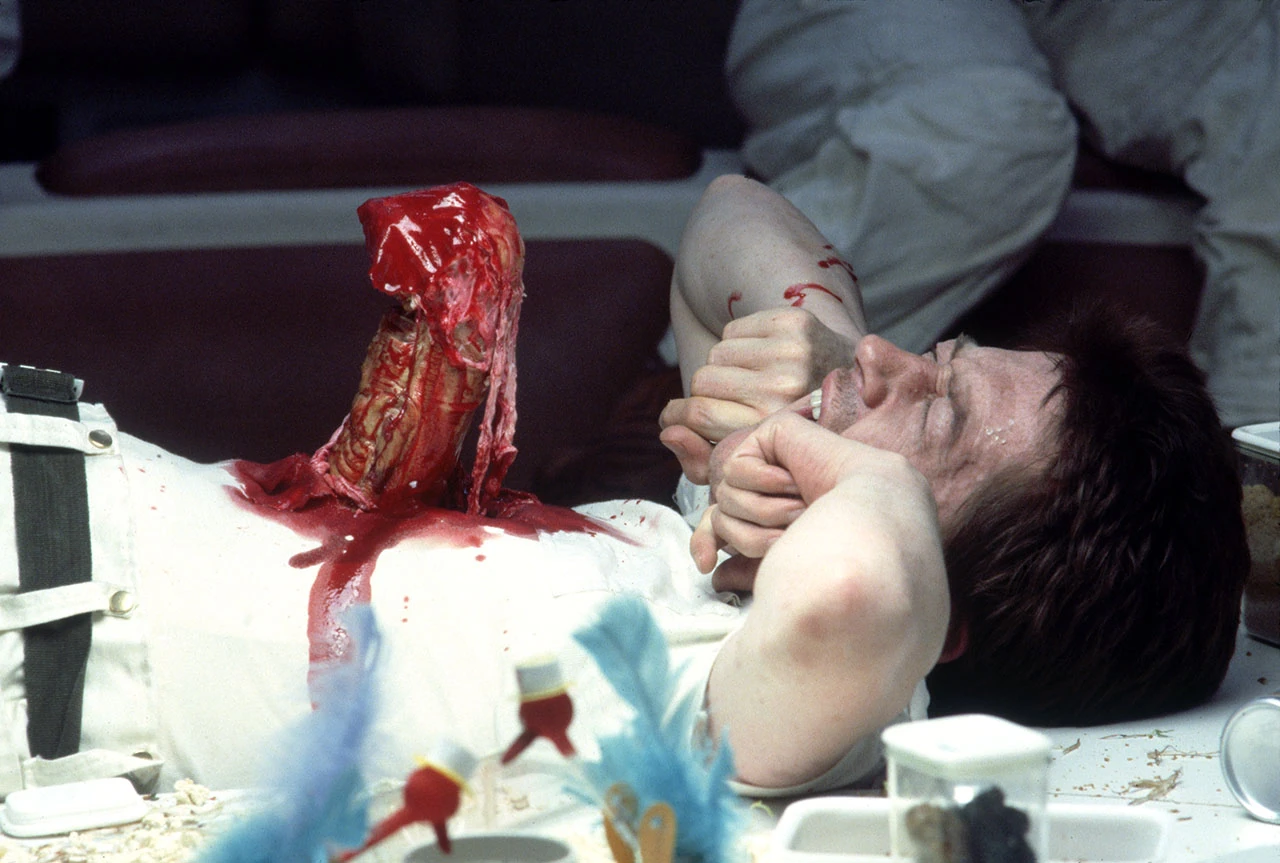
The early fleshy, birdlike concept often discussed in production histories is an unused design, not an independently observed species.
02Did the cast know what would happen?PRODUCTION
The widely repeated claim that the actors were entirely unaware of the scene is misleading. Veronica Cartwright recalls knowing the scripted emergence while not knowing exactly how the practical effect would be executed. Cast and crew accounts collected by The Guardian also distinguish knowledge of the scene from the surprise of its execution. The resulting reactions combine performance and real surprise; the details should not be inflated into an unsupported claim that the scene was unscripted. 11 12
03Stan Winston Studio and the 1986 revisionEFFECTS
The 1986 team reproduced the earlier design while adding movement to the small arms and body. Its cable-controlled puppet made the juvenile more expressive during the brief encounter in the hive. The studio’s behind-the-scenes description explicitly identifies the arms as a design decision to connect the juvenile’s anatomy to the adult. 13
The difference between the two puppets is an established production distinction. It does not prove the two juveniles have separate castes in-universe.
04Alien 3 and Resurrection — developmental redesignsEFFECTS
Alien 3’s creature work adapted the juvenile to a four-legged host concept. The alternate animal birth sequence and altered ending complicate any comparison made without identifying the cut. Alien Resurrection returned to a more familiar host-derived juvenile while introducing the separate live-born hybrid. 3 4 14
05Covenant — practical maquette and digital creatureEFFECTS
Framestore’s project account credits the combination of Scott’s drawing, Odd Studio’s articulated maquette and digital realization of the released Chestburster. Adam Johansen’s interview documents the practical creature work. The more adult-like outline is a design choice rather than proof of a different gestation duration by itself. 15 16
06Romulus — small scale, translucency and movementEFFECTS
Alec Gillis describes Álvarez’s preference for a slower, more sustained depiction of birth, and a smaller puppet than previous versions. Studio Gillis developed a more organic mechanism from concept work by Dane Hallett and subsequent digital sculpting. Fluid beneath the translucent dome produces the darkening effect. These are production techniques, not chemical measurements of the creature’s biology. Gillis’s proposed premature-birth interpretation is a creative rationale, not a stated universal biological rule. 17 18 19
07Alien: Earth — television practical effectsEFFECTS
In the 2026 interview published by The Credits, prosthetics supervisor Steve Painter identifies Arthur’s emergence as a complex practical sequence using an articulated silicone body and animatronic juvenile. The material was shot across a beach location and a studio backlot. This documents the actual television effect rather than assuming it reused a film puppet. 20 33
Related records
Section titled “Related records”- Xenomorph Egg (Ovomorph) — initial reproductive capsule.
- Xenomorph Drone — mature smooth-domed form and subsequent development.
- Xenomorph Warrior — hive defense and licensed soldier classification.
- Xenomorph Queen — reproductive adult and royal development.
References
Section titled “References”Released works are listed separately from creator testimony, game rules and secondary research leads. An indexed extract, a specific film scene or an archived comic panel does not establish every detail of an entire publication.
- Film: Alien (1979), Ridley Scott; Kane’s examination, galley scene, shed skin and mature Alien.
- Film: Aliens (1986), James Cameron; cocooned colonist, hive and medical laboratory.
- Film / editions: Alien 3 (1992), David Fincher; theatrical version and 2003 Assembly Cut (including alternate host and ending).
- Film: Alien Resurrection (1997), Jean-Pierre Jeunet; surgical recovery of Queen, Auriga laboratory, Purvis and the Newborn.
- Crossover film: Alien vs. Predator (2004), Paul W. S. Anderson; pyramid incubation and final Predator-host emergence.
- Crossover film: Aliens vs. Predator: Requiem (2007), Colin and Greg Strause; Predalien and hospital sequence.
- Film: Alien: Covenant (2017), Ridley Scott; Ledward, Hallett, Oram and Lope.
- Film: Alien: Romulus (2024), Fede Álvarez; Navarro, medical scanner, chrysalis and Offspring.
- Television: Alien: Earth (2025), season 1, episodes 3 (Metamorphosis), 6 (The Fly), 7 (Emergence).
- Creator interview: Roger Dicken: Monster Maker!; interview with the original effects artist.
- Cast / crew interview: The Guardian, The making of Alien’s chestburster scene (2009).
- Cast interview: Veronica Cartwright on Alien, ComingSoon (2017); script and effect distinction.
- Effects studio: Stan Winston School, Aliens Chestburster Mechanism; articulated arms and puppet.
- Production history: Monster Legacy, Alien³, the Dragon; alternate birth design and effects.
- Effects studio: Framestore, Alien: Covenant; Scott’s sketch, Odd Studio maquette and digital creature.
- Effects interview: Adam Johansen, practical creature effects, Alien: Covenant (2017).
- Effects interview: Ian Failes, Giving the chestburster its moment on screen (2024); Alec Gillis.
- Effects studio: Stan Winston School, The Practical Effects of Alien: Romulus; detailed puppet design.
- Concept artist interview: Dane Hallett, Alien: Romulus; creature and chrysalis designs.
- Effects interview: Bryan Abrams, Creature Discomforts, The Credits, 26 August 2026; Steve Painter and Jonathan Rothbart.
- Licensed RPG: Free League, ALIEN The Roleplaying Game (2019), core rulebook, Stage III pp. 305–307; original edition, pp. 302–306; Stage II and III text cross-checked against a searchable reproduction.
- Licensed RPG: Free League, ALIEN RPG Evolved Edition (2025), Stage III p. 215 and following; indexed extract, full pages pending.
- Publisher: Free League, ALIEN The Roleplaying Game / Evolved Edition.
- Game: Monolith, Aliens versus Predator 2 (2001), playable Alien campaign.
- Contemporary game coverage: PC Zone, Christmas 2001, review of Aliens versus Predator 2; playable life stages.
- Game manual: Electronic Arts / Zono, Aliens versus Predator: Extinction (2003), Alien faction rules and upgrade.
- Game database: MobyGames, Alien Trilogy (1996), enemy register.
- Comic / primary panel: Dark Horse Presents #24 (1988), Excerpts from the confidential paper Theory of Alien Propagation; archive panel, exact page pending.
- Bibliographic record: Grand Comics Database, Dark Horse Presents #24; eight-page story.
- Secondary comic lead: Aliens: Labyrinth (1993–94), account of Church’s experience; original issue/page pending.
- Short films: Alien: Night Shift and Alien: Ore (2019), 40th-anniversary shorts; individual scenes and credits to be verified for expanded index.
- Secondary research index: AvP Central, Chestburster: Anatomy, Bursting Methods & Life Cycle; leads for uncommon depictions, not independent proof.
- Television interview: David Rysdahl on Arthur’s emergence, TV Insider (2025).
- Secondary crossover research lead: Xenopedia, Chestburster; leads for surgical intervention and crossovers, exact issues pending.
- Licensed novel: Alan Dean Foster, Alien (1979), novelization; edition-specific details require page review.
- Licensed novel: Aliens: Labyrinth, S. D. Perry (1996), adaptation of the comic; comparison pending.
- Licensed novel: Aliens: Infiltrator, Weston Ochse (2021), prequel to Fireteam Elite; individual juvenile depictions require passage review.
- Production history: J. W. Rinzler, The Making of Alien (2019); print reference for early design and practical effects, pages pending.
We use optional analytics cookies to understand which pages are useful. Privacy policy